As 2025 approached, the farm felt full of promise.
The start of the year was beautiful in a way that felt almost effortless. White roses I’d planted were flowering. My dahlia garden was overflowing. The trees we’d put in over earlier seasons were beginning to take shape, their growth finally visible. Summer evenings were spent wandering the gardens, talking through plans for what might come next.
We’d walk down to the dam to throw sticks into the water for the dogs, or explore the mountains behind our house with the boys. There was a sense of ease of things unfolding as they should.

It felt, for a moment, complete.
Plans in Motion
We had moved through another lambing season and began thinking seriously about the next phase of the farm. An orchard. Chickens. Ducks. More food grown close to home. Systems that felt increasingly aligned with the life we were trying to build.
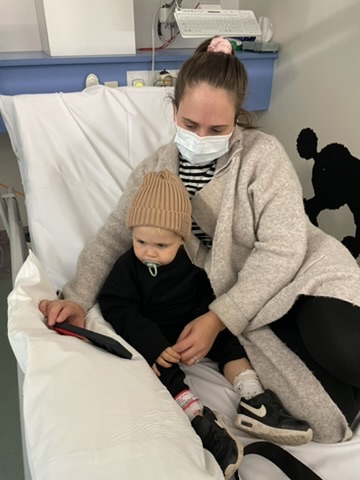
Then, in May 2025, everything changed. Our youngest son, Nicholas, was diagnosed with leukemia.
There’s no clean way to write that sentence. It marked a clear before and after.
Life on the farm didn’t end, but it did stop abruptly, completely. Plans were set aside. The future narrowed to the present moment. What mattered became very small and very clear.
To access treatment, I moved four hours away from the farm with Nicholas. Harrison stayed home with his dad so that some sense of normality could continue school, work, animals, the rhythms we’d worked so hard to establish.
The farm carried on, but in a different way. It held space rather than progress.
A Shift in Perspective
During that time away, our understanding of health began to change in ways that are difficult to articulate fully.
We became acutely aware of what we were putting into our bodies, what we were exposed to, and how deeply environment and food matter when the stakes are high. It wasn’t driven by fear, but by clarity the kind that strips things back to what is essential.
Farming, for us, was no longer just about self-sufficiency or producing food at home. It became about responsibility. About understanding our footprint, the systems we participate in, and the long-term impact of the choices we make, on our land, our bodies, and the world our children will inherit.
At the same time, we had to accept limits. The orchard plans were put on hold. The gardens paused. Everything unnecessary fell away while we focused on Nicholas and the road ahead.
Living Between Two Worlds

Treatment for childhood leukemia in Australia, specifically B-cell acute lymphoblastic leukemia, is a long process. If everything goes well, it spans around two years of active treatment, with roughly twelve months of that spent living away from home for active treatment. However, you aren’t considered ‘cured’ until 5 years with no relapse.
That knowledge reshaped how we thought about time and patience. It forced us to reckon with the reality that meaningful things, healing, soil, trees, systems, cannot be rushed.
And in that waiting, we began to understand something important: regeneration is not always visible. Sometimes it looks like growth. Other times, it looks like rest.
Learning to Farm With Intention
Our fourth season wasn’t defined by what we built, planted, or produced.
It was defined by what we protected.
The farm became a constant in a season of uncertainty, a reminder of home, stability, and continuity. A place rooted in longer timelines than any single year, holding space for us even when we couldn’t be present.
This season lit a fire in us to learn more deeply.
To understand regenerative farming not as a trend, but as a responsibility. To think carefully about inputs and outputs, about chemicals and soil biology, about water, biodiversity, and the unseen systems that support life. To ask harder questions about sustainability, not just environmentally, but emotionally and practically.
We don’t want to extract from this land. We want to improve it.
To leave it healthier, more resilient, and more alive than we found it.
Looking Forward
Intentional living, we’ve learned, isn’t about control.
It’s about adaptability. About responding thoughtfully when life changes course.
As we move forward, farming will continue to be an act of learning about regeneration, stewardship, and how to live within our means while caring for what sustains us. We started by reading everything we could find, some of those titles include – Dirt to Soil, by Gabe Brown, The Carbon Farming Solution, by Eric Toensmeier and Practical Self Sufficiency by Dick and James Strawbridge.
This season didn’t move us forward in the ways we expected.
But it changed the direction we’re walking.
And that may matter far more.
That leads us into our Fifth season 2026.
Leave a Reply